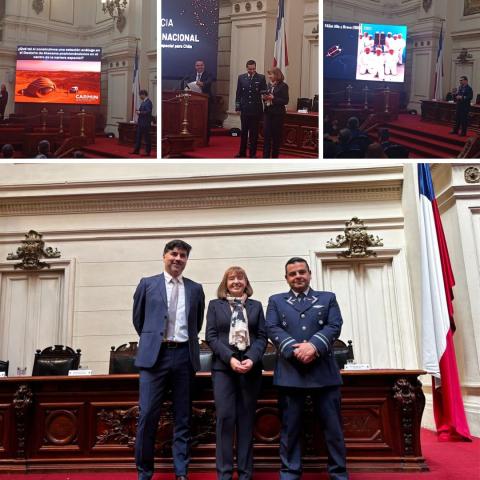
With a large audience and prominent figures from the political, academic, scientific, and defense sectors, the III Conference on “National Space Sovereignty” was held in the Hall of Honor of the former National Congress building. The conference has become a key forum for strategic reflection on the challenges and opportunities of space development in Chile.
The event was attended by the President of the Senate, Manuel José Ossandón; the Minister of National Defense, Adriana Delpiano; the Minister of Science, Technology, Knowledge and Innovation, Aldo Valle; and the Commander-in-Chief of the Chilean Air Force, General Hugo Rodríguez, along with representatives from the scientific, academic, and business communities.
Dr. Dora Altbir, recipient of the 2019 National Prize for Exact Sciences, Executive Director of the CEDENNA Foundation, and Director of Institutional Projects at Diego Portales University, offered a perspective from cutting-edge science on the role of research and nanotechnology in the national space ecosystem.
In her presentation, she highlighted how CEDENNA's experience demonstrates that having national scientific infrastructure and governance allows for the integration of diverse disciplines, the development of talent, and the promotion of innovation with real impact. She also emphasized that the National Space Center, soon to be inaugurated in Cerrillos, represents a unique opportunity for Chile to develop its own space capabilities, integrating defense, academia, industry, and society.
A country that looks to space as its new frontier
Minister Aldo Valle highlighted the country's progress in this area and announced details of the new National Space Center, which will feature over 5,800 m² of scientific and technological infrastructure, artificial intelligence, data science, and entrepreneurship laboratories, and a 600 m² cleanroom for manufacturing domestically engineered satellites.
“Space is a strategic resource for our security, integration, and development, but also for science, innovation, and well-being. This center will be a symbol of the Chile we want to build: a country capable of transforming knowledge into development and innovation into opportunities for its people,” Valle stated.
For her part, Minister Adriana Delpiano emphasized that space development must have a human face, and that technology only has meaning if it improves people's lives. “Chile has unique comparative advantages: a privileged geography, highly qualified human capital, and a solid institutional tradition. But space sovereignty must translate into better public services and opportunities for new generations. This meeting should not be just an event, but the beginning of a stage of full technological sovereignty,” he stated.
Shared vision of the future
During his address, the Commander-in-Chief of the Air Force, Air General Hugo Rodríguez, discussed the country's trajectory in the aerospace sector, highlighting the progress of the National Satellite System and the importance of establishing inter-institutional governance that strengthens collaboration between the State, academia, and industry.
"Talent combined with technical and professional education translates into technological sovereignty, and this, in turn, is the foundation for the design and applications derived from the use of space for the benefit of the population," he emphasized.
For his part, the President of the Senate, Manuel José Ossandón, stressed that space technology directly impacts daily life (from agriculture to telecommunications) and that technological independence is essential to protect individual freedom and the country's development. "Space sovereignty is also freedom. We cannot continue to depend on external capabilities. We have talent and a public-private partnership that we must strengthen," he stated.
A Strategic Perspective
Air Force Brigadier General (I) Jaime Rivera Candia, Director of Space for the Chilean Air Force, spoke about the country's historical evolution in aerospace and the progress of the National Satellite System, highlighting the importance of the National Space Center as a national infrastructure and an open, collaborative platform for science, industry, and academia.
“We are building a project in Cerrillos that will not only integrate our current capabilities but can also be replicated in regional centers, expanding our expertise and fostering local development. This model will allow us to decentralize space infrastructure, incorporate data centers, supercomputing, and geospatial information, and connect Chile to the world through knowledge,” General Rivera stated.
During his presentation, the Director of Space emphasized the importance of integrating nanotechnology into space development, highlighting CEDENNA's role in creating advanced materials to improve electrical conductivity and heat dissipation, critical aspects in the operation of satellites and data centers.
“If we can use nanotechnology to help reduce temperatures in large data centers, we will have a global competitive advantage. This is an example of how applied science can add value to copper and lithium, strengthening the country's technological sovereignty,” he added.
Finally, Chilean space architect José Miguel Armijo, a researcher affiliated with NASA and Axiom Space, presented his proposal for an analog station in the Atacama Desert, which would position Chile at the center of the international space race.
The project, CARMIN (Crewed Atacama Research for Mars Innovation), seeks to leverage the unique conditions of northern Chile to simulate Martian habitats, strengthening the country's research, engineering, and design capabilities.
- Log in to post comments