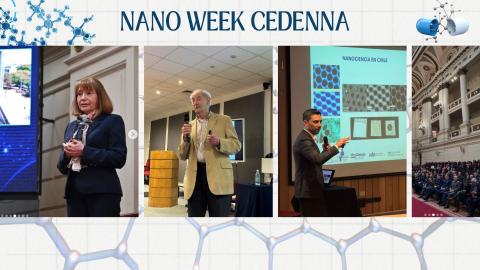
Open talks for students and teachers, an exhibition showcasing the most relevant research being conducted in Chile, and an opening conference led by Dr. Dora Altbir, 2019 National Prize for Exact Sciences recipient, along with government ministers, senators, and the Commander-in-Chief of the Chilean Air Force, marked the start of NanoWeek 2025, organized by the Center for Nanoscience and Nanotechnology (CEDENNA).
For a full week, CEDENNA transformed the traditional “NanoDay” into an extended celebration of knowledge, bringing nanoscience and nanotechnology closer to students, teachers, and the general public, and highlighting their role in building Chile's technological sovereignty.
Opening with a Forward-Looking Perspective
The week began on Monday, October 6, with Dr. Altbir's participation in the III Conference on National Space Sovereignty, organized by the Chilean Air Force (FACH) in the Hall of Honor of the former National Congress building. In the presence of the President of the Senate, Manuel José Ossandón; the Minister of National Defense, Adriana Delpiano; the Minister of Science, Technology, Knowledge and Innovation, Aldo Valle; and the Commander-in-Chief of the Chilean Air Force, General Hugo Rodríguez, the researcher reflected on the role of science and talent as drivers of technological sovereignty.
“Nanoscience teaches us that even the smallest things can transform the world. The same is true for knowledge: when the State, academia, and industry work together, the tiny becomes powerful,” said the executive director of the CEDENNA Foundation and director of Institutional Projects at Diego Portales University (UDP).
Her participation kicked off a week that put Chilean science at the center of the debate on innovation, sovereignty and development.
Talks and meetings to share science
On Wednesday, October 8, the day continued at UDP with two open lectures for students and faculty. Miguel Kiwi, winner of the National Prize for Exact Sciences, offered a fascinating overview of the origin and evolution of Quantum Mechanics, highlighting the contributions of its pioneers and the controversies that have marked its history. During his talk, he mentioned the scientific collaboration of his friend Cristian Urbina with Michel Devoret's team in the Quantronics group at CEA-Saclay, emphasizing how this connection links Chile to global quantum research and helps explain why Devoret, Clarke, and Martinis were recently awarded the 2025 Nobel Prize in Physics.
The University of Chile professor also addressed questions that remain relevant more than a century later: Young's experiment, the EPR paradox, and the enigmas that modern physics has yet to solve. With a profound yet engaging perspective, he reflected on the physical, philosophical, and practical consequences of this scientific revolution, emphasizing how nanoscience integrates physics, chemistry, biology, and engineering in a single effort to transform knowledge into well-being for society.
Meanwhile, Dr. Roberto Lavín presented an informative talk on Nanoscience and Nanotechnology, a clear and stimulating introduction to the world of the infinitely small. Through concrete examples and the developments driven by CEDENNA, he explained how research in nanometric materials is enabling Chilean innovations applied to mining, health, energy, and the environment, demonstrating that nanotechnology is not a science of the future, but a present-day tool that is improving everyday life.
The week will conclude this Friday, October 10, with an inspiring talk by Dr. Dora Altbir at Santa Ana School, where she will share with high school students how nanotechnology is transforming medicine, energy, and the environment. In addition, she will deliver a message especially to girls, encouraging them to dare to dream and pursue careers in science and STEM fields, just as she did.
Every October 9th, World Nanotechnology Day (NanoDay) is celebrated, a date that CEDENNA has commemorated since its inception. Founded in 2009, the Center brings together more than 70 PhDs and researchers from various universities across the country, who work collaboratively in 17 laboratories, integrating physics, chemistry, and biology to develop nanotechnology with a Chilean stamp.
From its laboratories have emerged more than 1,600 scientific publications, 65 patent applications, and collaborations with more than 100 national and international companies, solidifying the center as a Latin American leader in advanced research.
- Log in to post comments