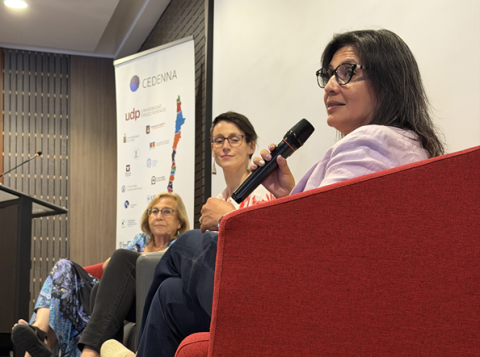
With a call to strengthen public policies that enable more women to fully develop their professional careers, the Center for Nanoscience and Nanotechnology (CEDENNA) commemorated International Women's Day with a day of reflection on female leadership in science and decision-making.
The event took place in the Auditorium of the Research Centers Building at the University of Santiago, Chile, and included the participation of university authorities, researchers, students, and representatives from the scientific community.
The meeting was opened by the Vice-Rector of the University of Santiago de Chile, Dr. Juan Escrig, who highlighted the importance of promoting spaces that allow reflection on the challenges faced by women in academia, research and the areas where relevant decisions are made for the development of the country.
The central moment was the discussion “Women, science and decision-making: real experiences in spaces of power”, which brought together former Minister of Health and Deputy Helia Molina, Mónica Antilén, CEDENNA researcher and director of the Institute for Sustainable Development of the Pontifical Catholic University of Chile, and Dr. Macarena Rojas Ábalos, biologist and master in journalism, president of the Chilean Association of Journalists and Professionals for Science Communication, ACHIPEC.
During the conversation, the panelists agreed that, although there has been progress in terms of equality, structural gaps still persist that hinder the full participation of women in different areas.
“True equality will only be achieved when there are public policies that allow women to fully develop. The State has a key role to play in ensuring that women can reach their full potential,” Helia Molina stated.
From the academic field, researcher Mónica Antilén highlighted the importance of scientific vocation and perseverance in the face of difficulties.
“Science is wonderful. When you truly understand it, you become passionate about it. In any field, there will always be obstacles, but when you are passionate about what you do, those challenges can be overcome,” he stated.
For her part, Macarena Rojas called on the younger generations to trust in their abilities and in the networks that are currently working toward greater equality in the scientific field. “To young women who are interested in science, I would say pursue your dreams. Today, there are many women—and many men too—working to level the playing field and open up more opportunities,” she stated.
At the close of the day, Dora Altbir, director of CEDENNA and winner of the 2019 National Prize for Exact Sciences, emphasized that creating these spaces for dialogue is key to moving towards a more diverse scientific system.
“There are still gaps we need to address, but we are also seeing more and more women developing high-level scientific careers. Identifying these gaps and proposing solutions is essential so that we have many more women in science in the future,” she said.
CEDENNA currently brings together researchers from 18 universities across the country, who work in an interdisciplinary manner on the development of nanoscience and nanotechnology and their applications in various productive and social fields.
- Log in to post comments