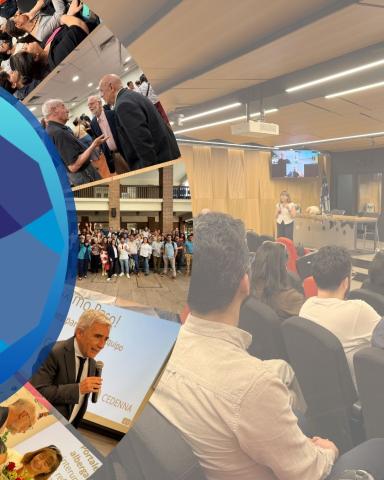
With a gathering that brought together researchers, as well as technical and administrative teams, the Center for Nanoscience and Nanotechnology (CEDENNA) officially launched a new stage as an Applied Research Center, following its success in securing the national ANID competition.
This new cycle positions the Center toward strengthening research with national impact, while preserving its multidisciplinary and interuniversity identity. Today, CEDENNA brings together academics from 18 universities across Chile.
During the event, the Center’s Director, Dr. Dora Altbir, emphasized that this new phase represents a process of consolidating capacities built over more than a decade, with a clear focus on generating concrete solutions to the country’s strategic challenges.
“Applied research allows us to transform advanced knowledge into real tools to improve people’s quality of life, strengthen industry, and contribute to public policies based on scientific evidence,” she noted.
Among the developments that reflect this approach are advances in the early diagnosis of neurodegenerative diseases such as Alzheimer’s and Parkinson’s through nanotechnology-based devices; new strategies in biomedicine, including nanoparticle-based cancer treatments; innovations in ocular health aimed at corneal regeneration; and applications in the environment, energy, and mining. All of these are areas where nanoscience opens up concrete opportunities for social and productive impact.
An interuniversity model hosted by Universidad Diego Portales
One of the central themes of the meeting was the collaborative nature of the project. In this context, the Rector of Universidad Diego Portales (UDP), Carlos Peña, emphasized that hosting the Center at UDP responds to an administrative and institutional support role, without altering the interuniversity essence of CEDENNA.
This approach reinforces CEDENNA’s vocation as a space for articulating diverse scientific capacities, where disciplines such as physics, chemistry, biology, medicine, and engineering converge, enabling complex problems to be addressed from complementary perspectives.
The importance of scientific communication and outreach as part of the Center’s core mission was also highlighted during the event. In this new stage, CEDENNA seeks to strengthen its dialogue not only with the academic community, but also with the State, industry, and the broader public, recognizing that science that is not communicated loses social impact.
Likewise, the role of cross-cutting committees, the active participation of each research line, and the collective commitment required to achieve the project’s goals were underscored. These include student training, technology transfer, and fulfillment of the contributions committed in this phase.
With this new phase, CEDENNA reaffirms its mission to contribute to Chile’s development through frontier science, consolidating itself as a national and international reference in nanoscience and nanotechnology, with a clear hallmark: one center, many universities, one shared goal—national impact.
- Log in to post comments